
Criminal Cases in Fairfield Courts
Fairfield has no municipal criminal court and no county criminal clerk. Connecticut Superior Court keeps the criminal file. Most Fairfield misdemeanors, motor-vehicle offenses, infractions, and class C, D, or E felony Part B matters go to Geographical Area No. 2 in Bridgeport. G.A. 2 is at 172 Golden Hill Street, Bridgeport, CT 06604, and its main number is (203) 579-6568. The public-information desk number is (203) 362-0150.
Serious class A and B felony work, plus serious cases transferred from the G.A. docket, principally proceeds in the Bridgeport Judicial District Part A court. That court is at 1061 Main Street, Bridgeport, CT 06604. Its main contact is (203) 579-7210, with public information at (203) 579-6193. The clerk records the filed charges, events, orders, outcome, and sentence. Fairfield Town Hall does not certify any of those results.
Fairfield Cases on Two Dockets
The split between Golden Hill Street and Main Street is a routing rule, not a minor address detail. The Fairfield Judicial District State's Attorney describes Part A as the office for the most serious criminal work, while the G.A. Part B office handles the bulk of other criminal matters. A person who searches only one courthouse can miss a Fairfield case that was transferred or placed on the other docket.
The official prosecutor page shows the local case structure without turning the prosecutor's file into a public court file. The prosecution office serves Fairfield along with Bridgeport, Easton, Monroe, Stratford, and Trumbull. The clerk remains the source for certified court records. The image below comes from that official local prosecution page.
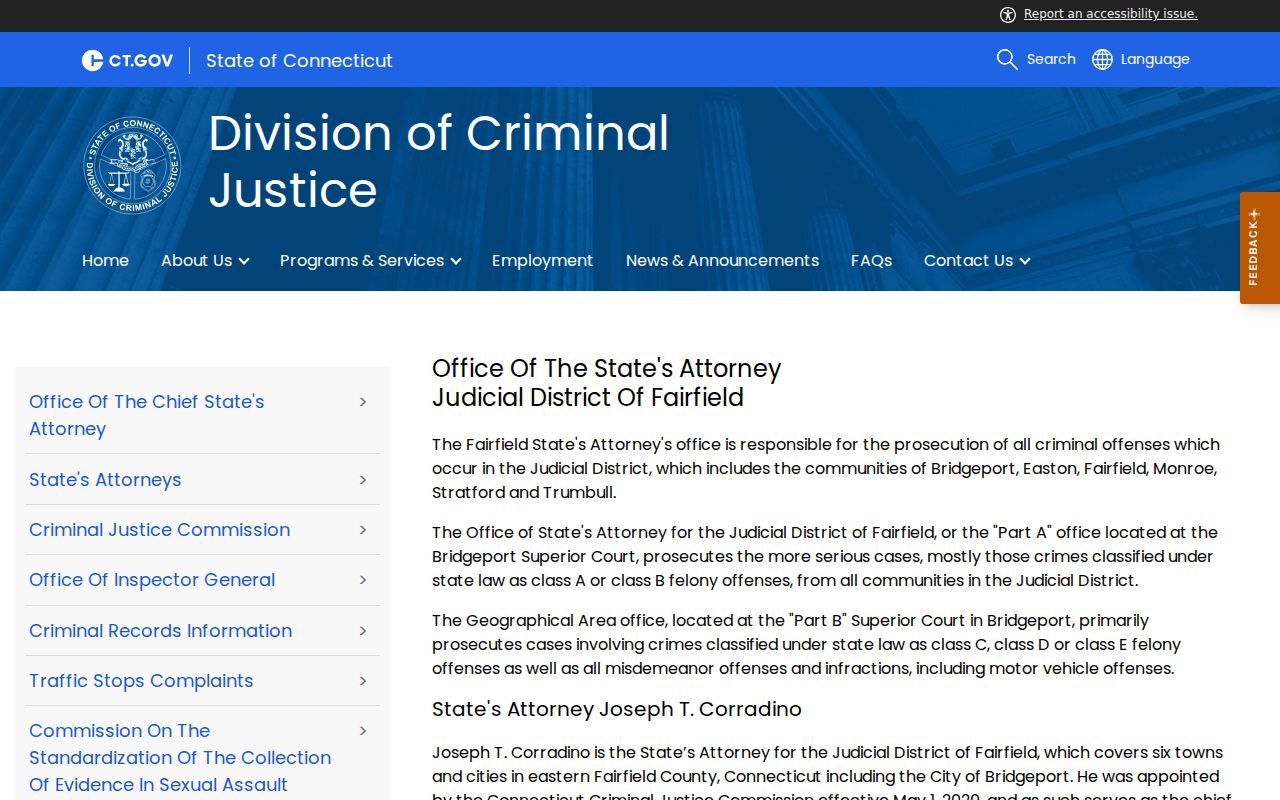
That structure helps explain why a Fairfield police charge may appear under Bridgeport in the public court system.
How to Search Case Records
The Connecticut Criminal/Motor Vehicle Case Look-up separates pending cases, convictions, daily dockets, defendant searches, docket-number searches, and warrant-related views. Use the view that answers the actual question. Pending Case covers an active prosecution. Convictions covers displayed judgments. Daily Docket is for scheduled court activity. A docket number is more precise than a name once it is known.
- Open the Judicial Branch criminal gateway and choose Pending Case, Convictions, or Daily Docket.
- Search by defendant name when the docket is unknown. Try the exact spelling and sensible name variants.
- Use docket search after confirming the identifier. For Fairfield Part B cases, the location code commonly begins F02B.
- Record the court, status, charges, next event, disposition, and sentence without merging them with police allegations.
- Contact the correct Bridgeport clerk for a certified disposition, an older record, or a document that the public view does not provide.
| Field Label | Type | Required | Notes |
|---|---|---|---|
| Last name | Text | Name search | Use the defendant's court spelling and test hyphens or aliases when supported. |
| First name | Text | Name search | Narrows common surnames; a middle name may affect the match. |
| Docket number | Text | Docket search | Best identifier once confirmed; F02B denotes Bridgeport G.A. 2. |
| Search view | Choice | Yes | Pending, conviction, and daily docket answer different questions. |
| Court location | Location | Contextual | Check G.A. 2 and Judicial District routing when needed. |
The official lookup page shown below also carries the publication warning. It is a useful index, but it is not a certified lifetime criminal history.
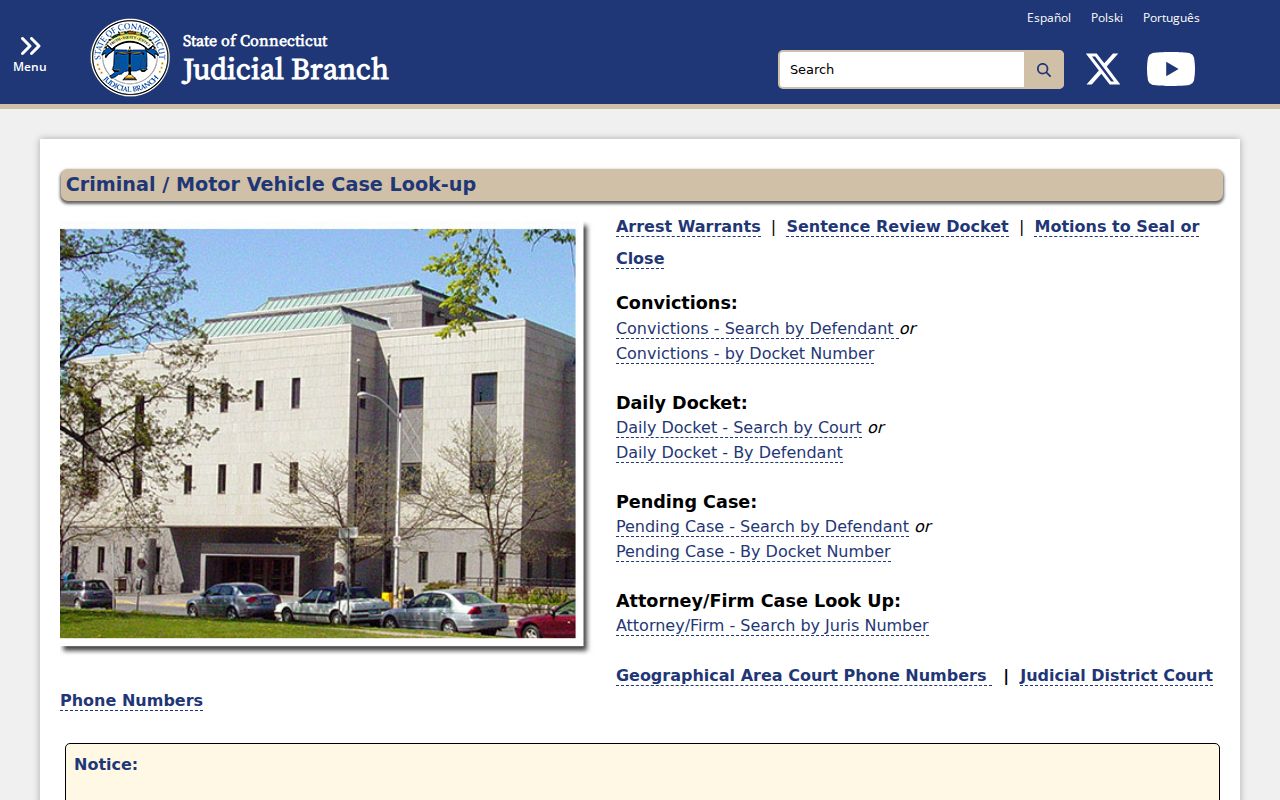
Save the query spelling, date searched, docket number, and court so a later clerk request can be specific.
Fairfield Court Clerk Fallbacks
Online entries do not always include the charging paper, motions, exhibits, or a downloadable judgment. The Judicial Branch public-information desk directory identifies contacts for both Bridgeport courthouses. Ask which clerk holds the docket before traveling. State facilities use security screening, and current direction pages should control parking, entrance, access, and closure details.
The official public-information desk view is reproduced below from the manifest source. It reinforces the two-building fallback rather than suggesting a nonexistent Fairfield courthouse counter.
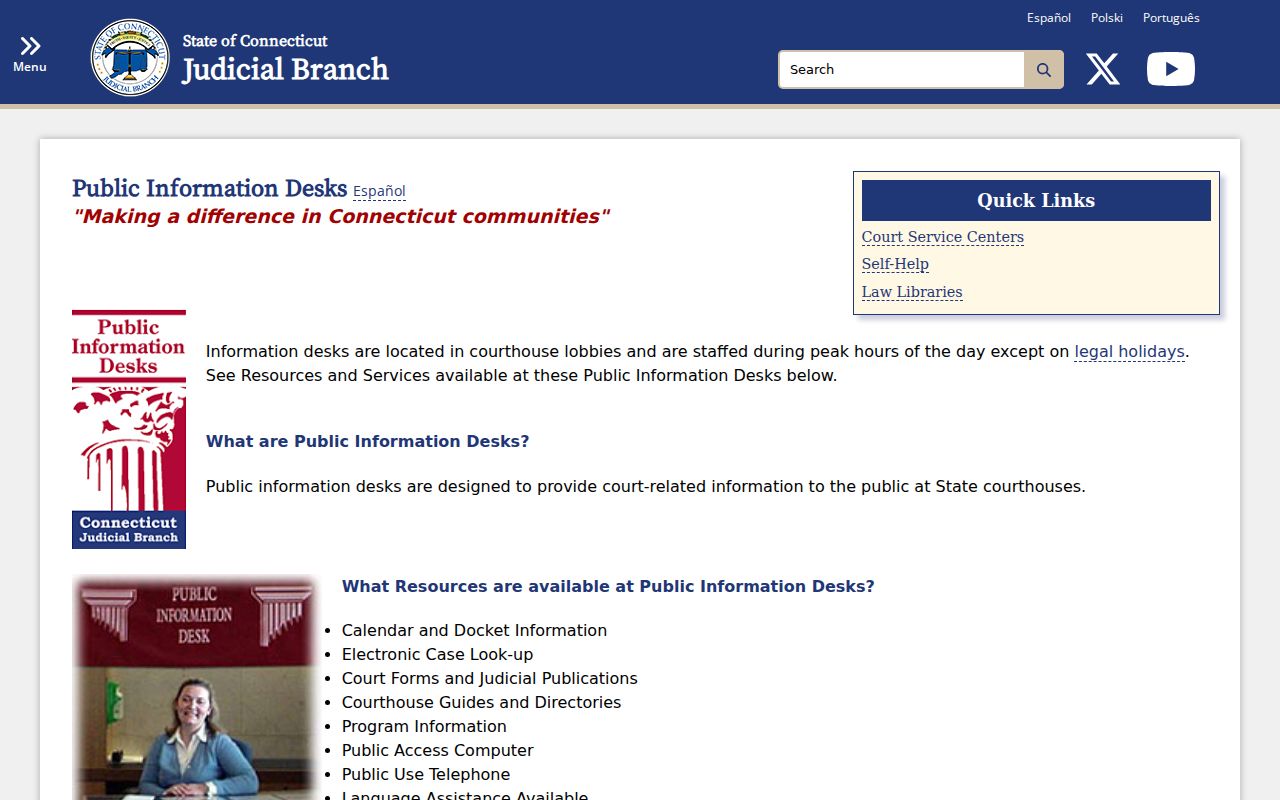
For the final legal outcome, request a certified disposition from the clerk instead of relying on a police narrative or a search result alone.
What the Case File Shows
A Fairfield criminal case entry organizes one prosecution. The header ties the defendant, docket, court, case type, status, originating police agency when shown, arrest date, and file date together. Charge rows can list the count, statute, offense text, class, plea, finding, disposition date, and sentence. Public entries may also show bond or promise-to-appear data, counsel, scheduled events, and warrant activity.
| Case Number & Court | The unique docket and the Bridgeport G.A. or Judicial District location. |
|---|---|
| Charging Document | The counts pursued by the prosecutor, which can differ from the arresting officer's first list. |
| Docket Entries | Arraignment, continuances, motions, pleas, findings, warrants, and postjudgment events. |
| Hearing Dates | Past events and the next scheduled appearance when publicly displayed. |
| Disposition & Judgment | Nolle, dismissal, acquittal, guilty plea, or conviction after trial, each with a distinct meaning. |
| Sentence & Conditions | Incarceration, suspended time, probation, conditional discharge, fines, or restitution when shown. |
Many criminal documents still require clerk access. Public files exclude Social Security numbers and may limit birth dates. Victim and minor identities are not search fields. Juvenile, youthful-offender, sealed, and erased matters should not be expected in the public result.
Read Fairfield Docket Terms Carefully
Small words on a docket carry large differences. A status of “disposed” means the court concluded the main action; it does not automatically mean convicted. The terms below help keep a Fairfield court record separate from assumptions about guilt or custody.
- Arraignment
- The first formal court presentation of the charges.
- Nolle prosequi
- A prosecutor declines to continue the charge; statutory erasure ordinarily follows after 13 months if prosecution is not resumed.
- Disposition
- The recorded outcome, such as dismissal, acquittal, plea, or trial judgment.
- Promise to appear
- Release without cash security, conditioned on attending court.
- Re-arrest warrant
- A warrant often issued after a missed court date.
Note: “Disposed” describes procedural completion and must not be restated as “convicted” without the actual judgment.
Stages of a Criminal Case
A Fairfield case can begin with a custodial arrest, summons, or warrant execution. A release or detention choice follows. Prosecutors then review the evidence and decide which counts to file. At arraignment, the court addresses the charges and release terms. Disclosure, conferences, and motions shape the pretrial stage. The case may end with a plea, trial, dismissal, or nolle before any sentence is entered.
Case flow: Charges Filed › Arraignment › Pretrial › Plea or Trial › Disposition › Sentencing
The arresting officer's allegations do not freeze the court case. A prosecutor may decline, add, replace, or reduce counts. Later events may include an appeal, probation violation, sentence review, or re-arrest warrant. Read each event in date order and use the judgment to identify the formal outcome.
When Fairfield Cases Move
The Bridgeport Judicial District courthouse page is the official source for the Part A location. A serious Fairfield prosecution may appear there after starting through another part of the system. “Principally” is the key qualifier because procedural transfers and case decisions prevent a rigid promise based only on an offense class.
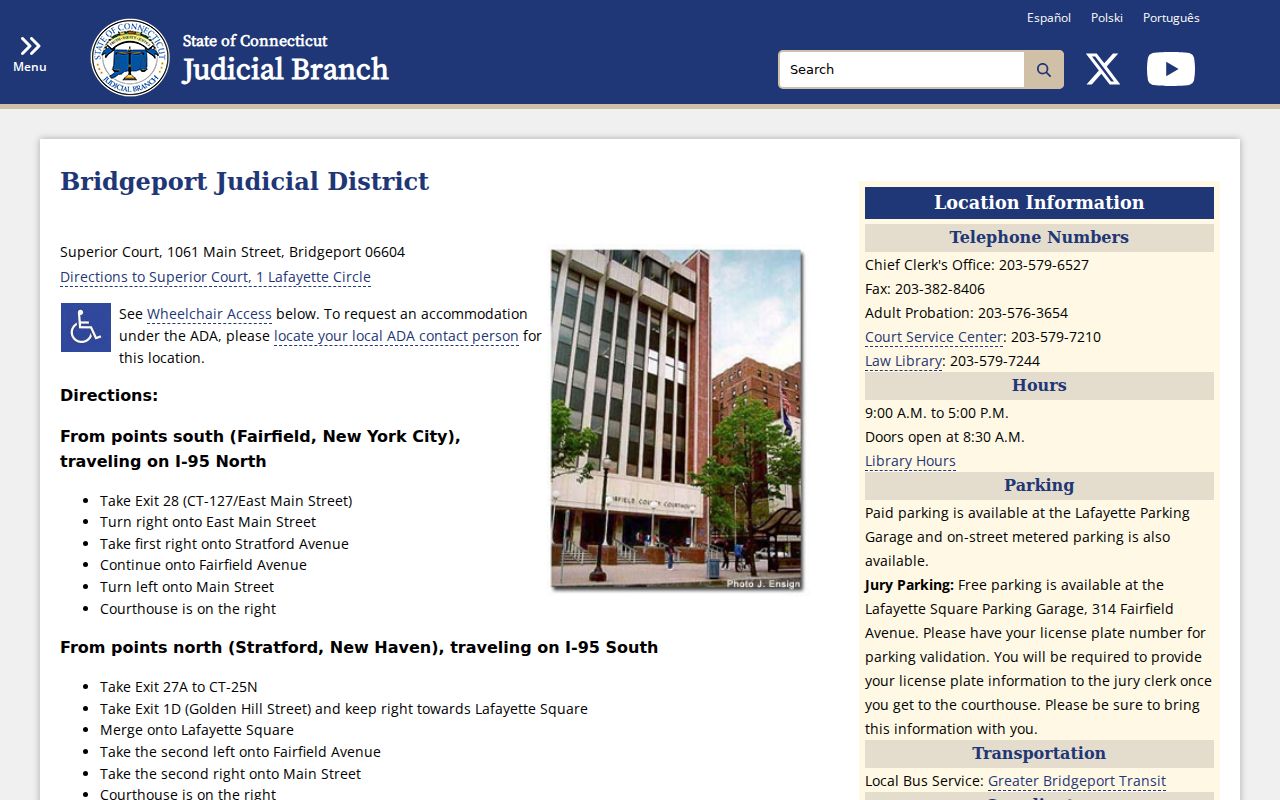
This courthouse image gives the serious-felony branch a concrete source without implying that Fairfield operates its own criminal court.
The current Judicial District assignment page should be checked before directing a question to a specific courtroom.
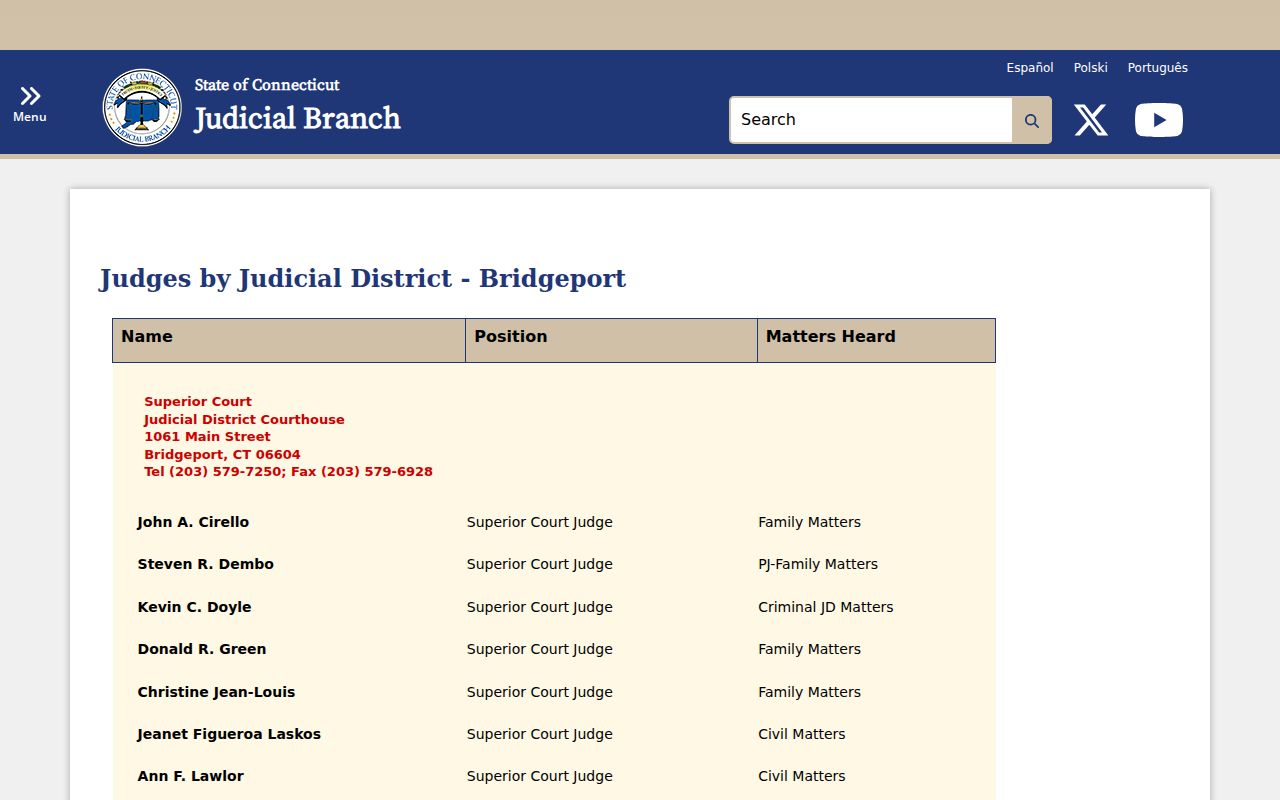
Judge assignments can change, while the docket number and clerk location remain the sound starting points.
Fairfield Cases at Golden Hill
The G.A. 2 direction page anchors the most common Fairfield criminal venue at 172 Golden Hill Street. It serves Part B work, which principally includes misdemeanors, infractions, motor-vehicle offenses, and class C, D, or E felonies. That does not turn the location into a town or county court.
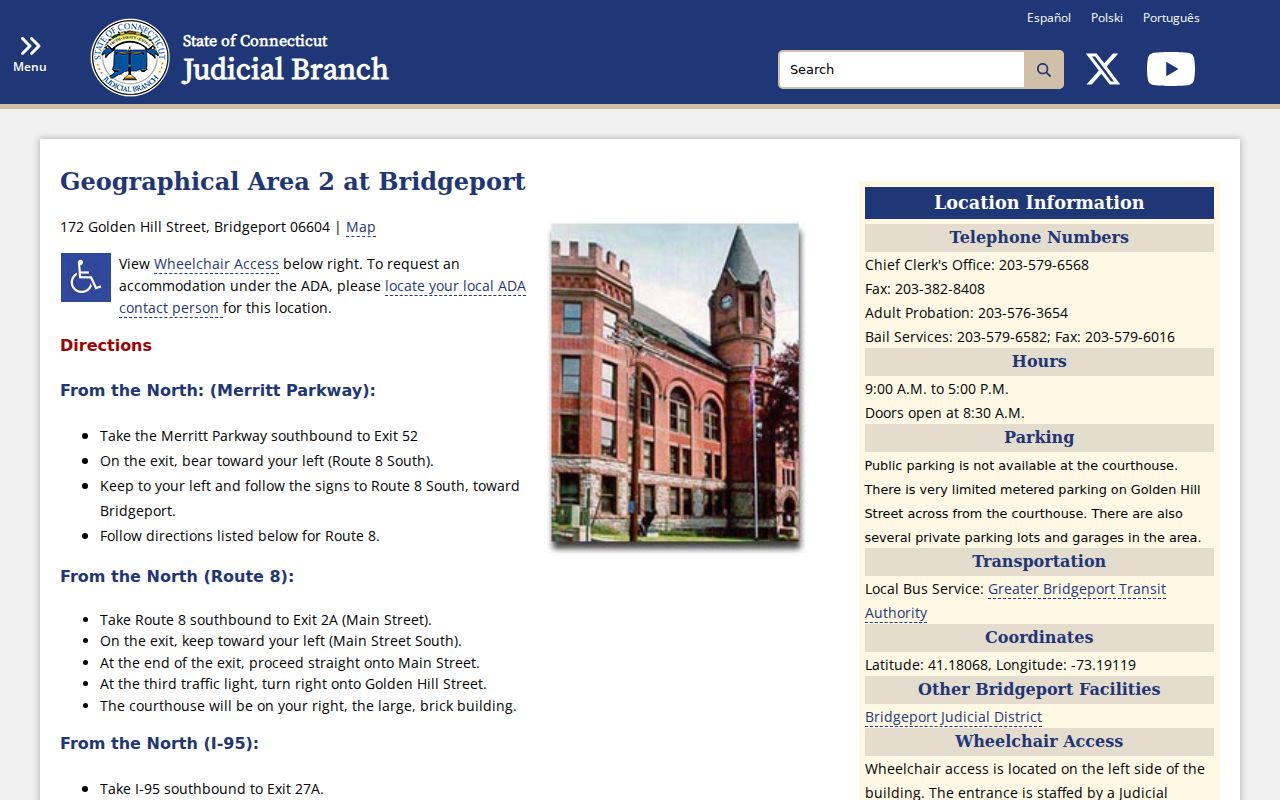
The official courthouse view is useful when a docket directs the reader to G.A. 2 for a clerk request or scheduled event.
Access & Restrictions
Connecticut's public court tools have deliberate limits. Conviction information is generally displayed for no more than ten years from sentencing, and Practice Book §7-13 can shorten the period. Removal may occur one month before the end. The site also excludes juvenile and youthful-offender cases and infraction or violation convictions. Erasures, corrections, and pardons can change results daily.
A no-result search therefore does not certify that no Fairfield court record exists. Check the spelling, choose the right pending or conviction view, search both likely Bridgeport locations, and contact the clerk for an older case. Connecticut's erasure law, including Chapter 961a, can bar ordinary disclosure of erased records. Victim data, sealed material, and confidential youth records also remain restricted.
For a broader look at how a police event differs from the court outcome, the Fairfield arrest history page follows the local report and custody channels. Keep the sources side by side rather than treating them as one document.