
How to Check Fairfield History
Begin with the event, not a broad name search. Fairfield Police Department records answer what officers reported. The Connecticut Judicial Branch answers what prosecutors filed and how a court handled the case. The Connecticut Department of Correction answers current custody questions. The State Police Bureau of Identification, or SPBI, supplies the official Connecticut criminal-history product. Each source has its own update schedule and exclusions.
Use a full legal name, date of birth when accepted, approximate event date, and known docket or incident number. Keep a note of the spelling, search date, chosen database, and result. That small audit trail helps when two people share a name or when a record changes after an erasure, correction, or court event.
The search sequence also depends on timing. FPD publishes a three-business-day minimum for a report. DOC data changes daily, and Judicial Branch results can change daily after court action, corrections, pardons, or erasure. A fresh event may appear in one system before another. Repeat the narrow search and call the correct custodian instead of treating an early blank screen as a final answer.
- Identify whether the source event involved FPD, State Police, or campus public safety.
- Search pending cases, convictions, and the Daily Docket separately in the Judicial Branch gateway.
- Check DOC when the question is current state custody, using a DOC number when known.
- Request the underlying Fairfield police report or certified court disposition.
- Use SPBI/CCHRS for an official statewide self-record or fingerprint-supported result.
Where Fairfield Criminal Records Live
Connecticut abolished county government. Fairfield is a town, so there is no Fairfield county sheriff, county jail, county clerk, or town criminal court. Local reports begin at the Fairfield Police Department. Most prosecutions move to Superior Court, Geographical Area No. 2 in Bridgeport. Serious Part A matters use the Judicial District courthouse on Main Street. State agencies in turn maintain the fingerprint repository, custody system, registry, probation, and parole records.
The official FPD homepage shows the department and its Reef Road headquarters. That source provides the right first contact for a town police event.
The image anchors the local end of a record chain that can continue west to Bridgeport courts and north to state offices in Middletown.
Official Connecticut Background Checks
SPBI is Connecticut's central repository. A name and date-of-birth search can confuse people with similar identity data, while fingerprints tie the request to a specific person. DESPP's DPS-0846-C form lists a $36 existence-only search and a $75 Connecticut conviction-history search. The fingerprint product also lists $75, with a separate collection charge. Agency service codes and live CCHRS workflows can produce different totals, so confirm the current checkout before paying.
The SPBI criminal-history page explains the current request channels. Its captured interface distinguishes state record products instead of treating every check as the same service.
Use the result for its stated purpose and scope. A repository response is not a replacement for a certified court disposition.
| Product | Published amount | What it means |
|---|---|---|
| Name/DOB existence search | $36 | Reports whether a Connecticut record exists, not the record itself |
| Conviction-history search | $75 | Supplies a copy if a matching conviction record exists |
| Fingerprint collection at DESPP | $15 | Collection fee, separate from the record product |
| Federal component when authorized | $13.25 | Separate component that does not apply to every request |
CCHRS Fingerprinting from Fairfield
The Connecticut Criminal History Request System handles pre-enrollment and agency-coded requests. Enter the service code supplied by the requesting authority, complete the identity fields, keep the barcode or confirmation, and follow the stated fingerprint site instructions. Do not pick a product by price alone. The code governs the authorized search and its components.
This CCHRS capture shows why pre-enrollment comes before fingerprint collection.
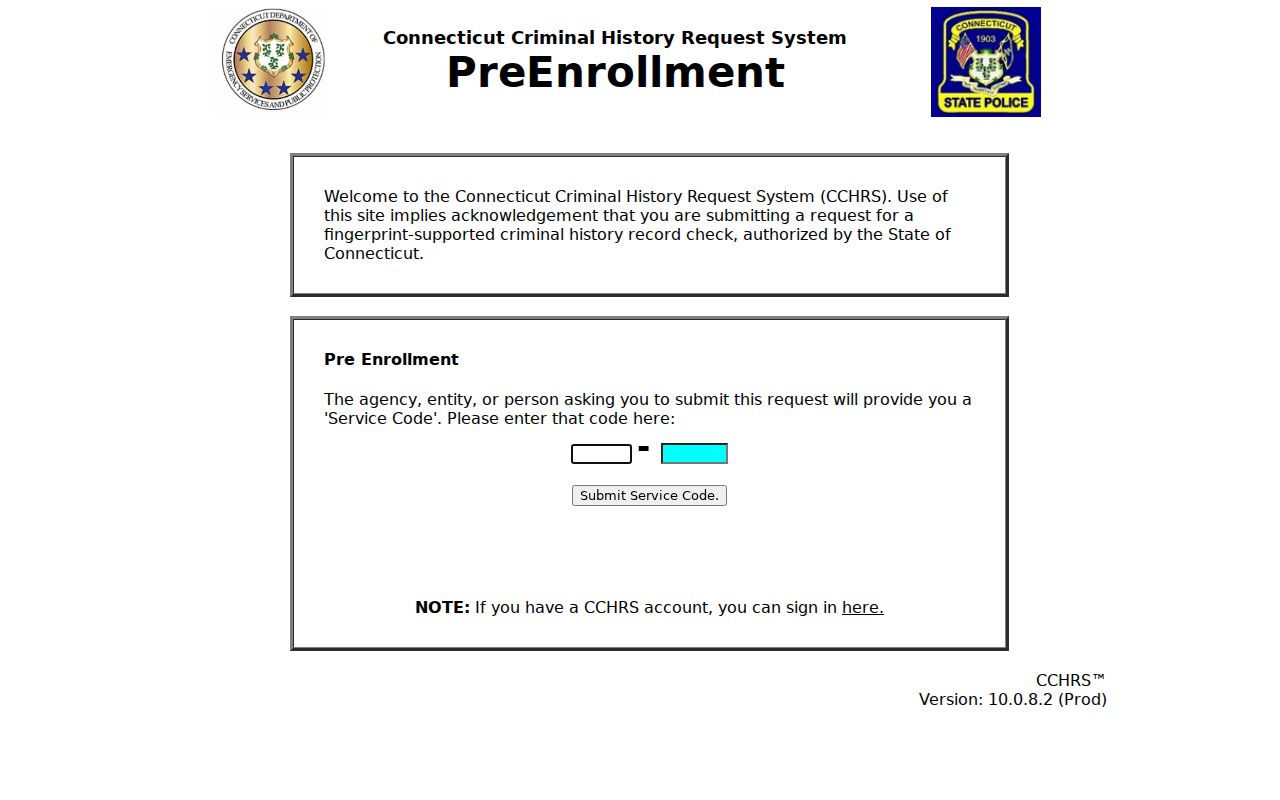
The portal is a state channel, not a Fairfield police report search. Results follow SPBI procedures.
Fairfield Police also offers appointment-based fingerprinting at 100 Reef Road. Its fingerprint appointment page shows the available local route.
Bring the exact documents and codes required by the current appointment instructions. Fingerprint capture alone does not create a record request.
Types of Fairfield Criminal Records
A single event can create several files, and they answer different questions. The local incident report records what officers observed or were told. An arrest supplement states the alleged basis for taking a person into custody. Prosecutors may later decline, add, reduce, or substitute charges. The court docket then records appearances, pleas, findings, disposition, and sentence. SPBI links fingerprint-supported arrest cycles with reported outcomes.
- Police records: incident, arrest, evidence, crash, dispatch, and releasable media held by the creating agency.
- Court files: filed charges, docket events, bond, pleas, dispositions, and sentences held by Connecticut Superior Court.
- Custody records: current accused or sentenced status maintained by Connecticut DOC.
- Repository history: state arrest cycles and reported outcomes maintained by SPBI.
- Registry and supervision records: narrow public information maintained by state registry, probation, parole, or pardon authorities.
Three Records Behind One Arrest
Do not merge the police narrative, court docket, and rap sheet. The FPD report states probable-cause allegations and may contain witness or evidence detail subject to redaction. The prosecutor's charge is the count pursued in court. The docket gives the procedural history and formal outcome. The SPBI record is a state identity-linked summary, which may lag when a disposition is missing or newly corrected.
| Source | Best use | Key limit |
|---|---|---|
| FPD report | Understand the local police event | Allegations are not findings of guilt |
| Judicial docket | Track charges and outcome | Public conviction display is generally time-limited |
| SPBI history | Review the state repository record | Matching and disposition reporting can require correction |
Compare the exact statute, event date, docket number, and disposition. “Disposed” only means that court processing ended. It does not automatically mean convicted.
What a Fairfield Record Shows
Available fields depend on the custodian and disclosure rules. Identity details may include the displayed name, aliases, date-of-birth information, physical descriptors, and agency numbers. Event fields can include arrest date, police agency, alleged charge, court location, bond, and next appearance. Outcome fields can include plea, finding, disposition date, sentence, probation, or conditional discharge.
| Name & Identifiers | Displayed legal name, aliases, DOB limits, docket, incident, booking, or DOC number |
|---|---|
| Arrest Data | Agency, date, alleged statutes, warrant basis, and release or bond information |
| Case Data | Court, status, counts, events, counsel, plea, finding, and disposition |
| Sentence | Effective incarceration, suspended time, probation, conditional discharge, or financial orders when public |
| Restrictions | Juvenile, youthful-offender, victim, medical, sealed, erased, and active-investigation data may be absent or redacted |
Fairfield Reports at Reef Road
FPD says routine incident reports are paper-only at headquarters and need at least three business days before release review. Call Records at (203) 254-4800, option 1, before traveling. Published counter hours are Monday through Friday, 8:00 a.m. to 3:30 p.m., and Saturday during the same span with a noon to 1:00 p.m. closure. Staffing can change hours.
Basic copies cost $0.50 per page. A certified copy costs $1.50 for the first page and $0.50 for each later page. Digital media is listed at $10 per USB or DVD. Fairfield is cashless, so use a credit card, check, or money order. These amounts may change.
FPD Records/Evidence
100 Reef Road
Fairfield, CT 06824
(203) 254-4800, option 1
Call first for availability and hours
Superior Court G.A. 2
172 Golden Hill Street
Bridgeport, CT 06604
(203) 579-6568
Most Fairfield criminal dockets
SPBI
1111 Country Club Road
Middletown, CT 06457-2389
(860) 685-8480
State criminal-history repository
Note: Request a routine paper report at the counter; use Fairfield NextRequest for broader electronic records such as CAD data, audio, or video.
Fairfield NextRequest Beyond Paper
FPD routes formal Freedom of Information requests through the Town of Fairfield NextRequest portal. Describe an existing record, not a question for the department to answer. Include the incident or CAD number when known, date and narrow time span, location, involved unit if known, and preferred electronic format. The portal keeps clarification messages, fee estimates, exemption notices, and release links together.
| Channel | Use it for | Prepare |
|---|---|---|
| FPD counter | Routine releasable paper incident report | Incident number, date, parties or location |
| NextRequest | 911 audio, CAD, body-camera video, logs, policies | Agency, exact record, time range, location, format |
| Crash-report route | Official Fairfield accident report | Crash details required by the current FPD instructions |
| Superior Court clerk | Certified criminal disposition | Docket number, defendant name, court location |
If part of a record is exempt, ask for the reasonably segregable remainder. FOI gives access to existing public records; it does not force an office to create research, explain an officer's decision, or compile a new report.
Keep the portal correspondence with the released file. It documents the request wording, the department searched, any fee estimate, and each cited exemption. If a production seems incomplete, compare that history with the original incident number and requested time span. A narrow follow-up can identify a missing arrest supplement, dispatch segment, or final releasable report without asking FPD to reconstruct an event from scratch.
Fairfield Criminal Record Access Laws
Connecticut law starts with access but protects defined categories. Police records can be withheld or redacted when disclosure would prejudice an active investigation, reveal protected victim information, expose juvenile or youthful-offender material, or disclose an erased record. A temporary investigative limit is different from a permanent confidentiality rule.
Key Statutes:
Connecticut Freedom of Information Act gives access to nonexempt records held by public agencies.
Chapter 961a governs criminal-record dissemination, erasure, and related update duties.
Conn. Gen. Stat. §54-142a provides erasure routes for specified nonconviction and other eligible outcomes.
Conn. Gen. Stat. §54-142e requires covered recipients of erasure updates to delete affected data within the statutory period.
The Connecticut Freedom of Information Commission reviews disclosure disputes. An agency's first denial is not always the final word, but deadlines apply.
Different restrictions also last for different periods. An active-investigation limit may end as the case develops. Juvenile and youthful-offender confidentiality follows the case status. Victim protections can require lasting redaction, while statutory erasure bars ordinary disclosure of the erased record's existence. That is why a useful response names the withheld portion and legal ground instead of labeling the entire Fairfield file public or confidential.
Fairfield Has No Jail Roster
Connecticut DOC holds pretrial detainees as well as sentenced people. That makes the statewide inmate search relevant soon after a Fairfield arrest, but it also makes careful wording vital. A DOC match may show accused status while a prosecution is pending. It is not proof of conviction. Search by DOC number when known, or use name and date of birth, then record the date because DOC says its data changes daily.
A missing result can reflect spelling, timing, release, Youthful Offender exclusion, ICE-only custody, or a different system. Check the pending case and Daily Docket rather than concluding that no arrest occurred. Bridgeport Correctional Center is a state facility, not a Fairfield or county jail.
Fairfield Warrant Search Limits
PRAWN and COLLECT are law-enforcement systems, not complete public warrant searches. The Judicial Branch gateway offers some warrant-related categories, including violation-of-probation warrants, yet a blank result is not official clearance. A bench or re-arrest warrant can follow failure to appear, while an arrest warrant rests on a probable-cause finding.
For a suspected warrant in one's own case, contact the clerk tied to the docket and obtain legal advice before appearing. FPD can explain safe surrender procedure, but it cannot give legal strategy. Confirm resolution with the issuing court because connected systems may update at different times.
Erased and Restricted Fairfield Records
“Erasure” is Connecticut's statutory term. Dismissals, acquittals, qualifying nolles, decriminalized offenses, Clean Slate relief, and Absolute Pardons follow distinct paths. An Absolute Pardon results in full erasure of the official adult Connecticut record. Clean Slate automates erasure for qualifying convictions, while §54-142t provides a review route when an eligible record was not marked erased.
The official pardon guidance explains the current process and effect.
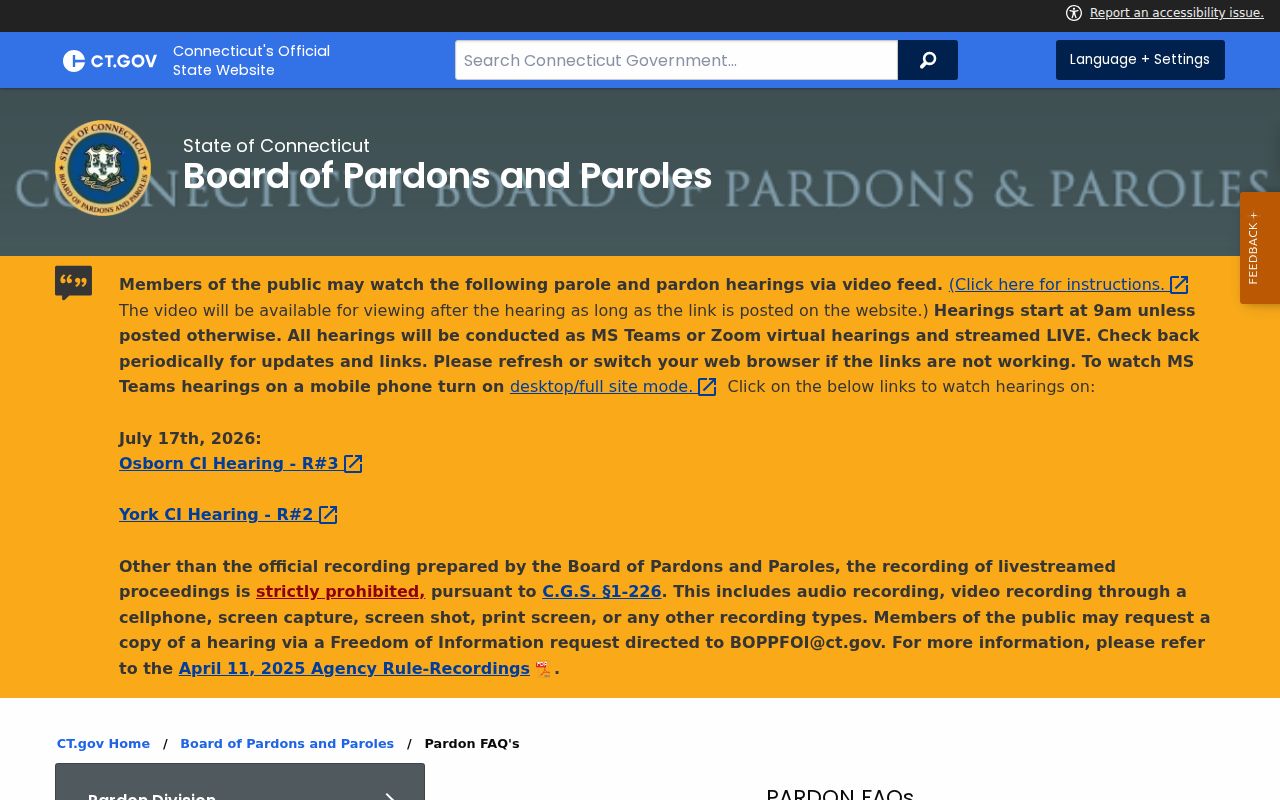
Keep certified disposition or pardon records. They can help identify which source needs correction when an erased case still appears downstream.
The statutory text provides the controlling detail for criminal-record erasure.
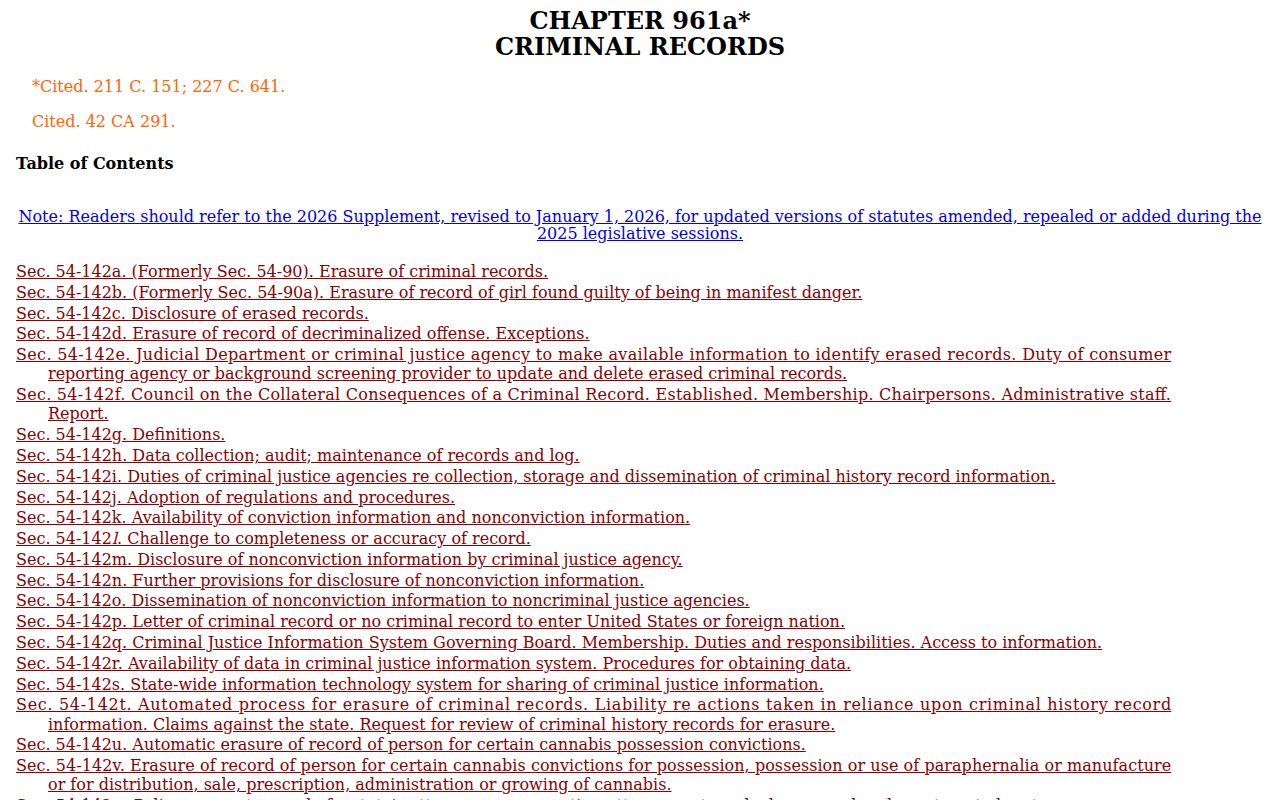
Correct the source system first: FPD for a report issue, the clerk for a docket issue, or SPBI for a repository mismatch. One correction may not reach every copy at once.
Fairfield Probation and Parole
Adult probation is a Connecticut Judicial Branch function based in Bridgeport, not a Fairfield town department. A public docket may show that probation was imposed, but officer notes, treatment information, home addresses, and detailed conditions are generally not public search fields. Parole decisions come from the Connecticut Board of Pardons and Paroles, while DOC Parole and Community Services supervises release.
The official parole eligibility material explains the state's general 50-percent and 85-percent consideration rules, subject to offense, sentence, credits, and exclusions.
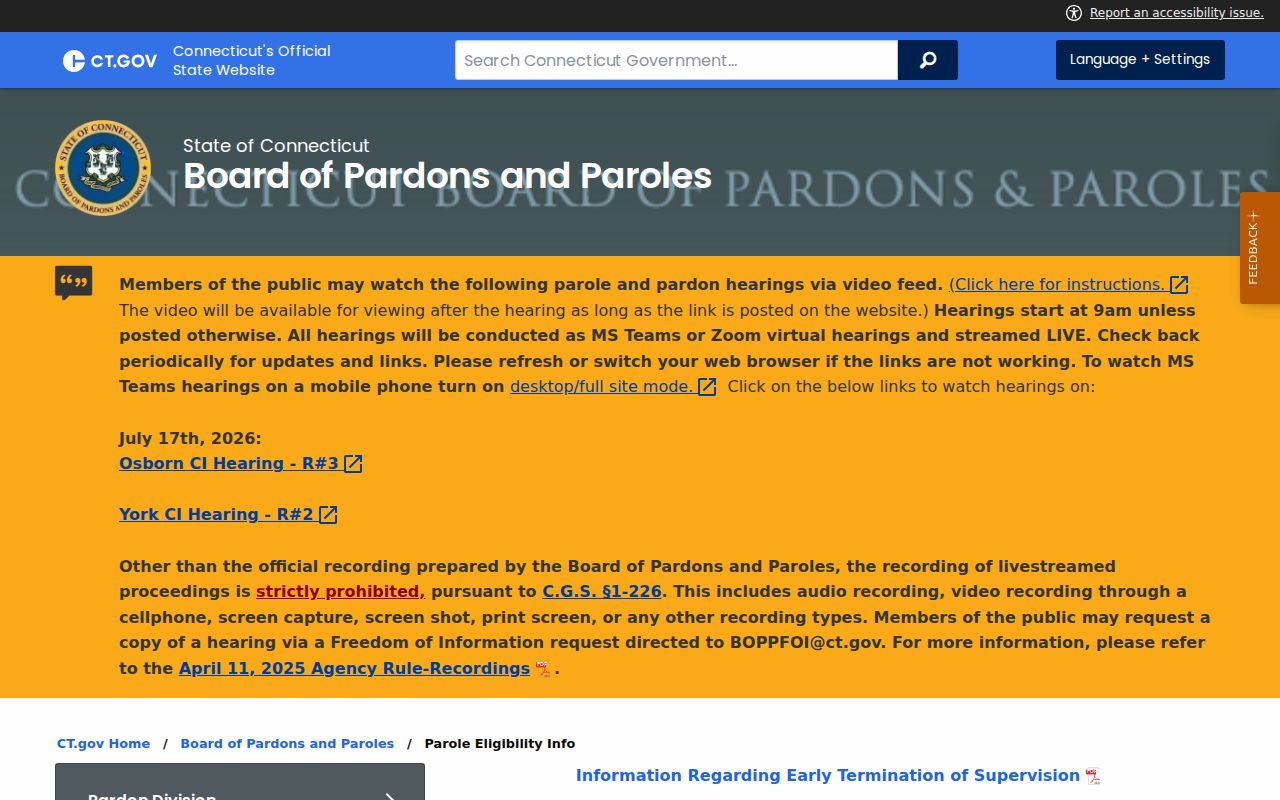
Probation and parole are not synonyms. Verify a person's own status with the responsible office and the controlling court or DOC record.
Federal Records Affecting Fairfield
Federal criminal cases do not appear as Fairfield Superior Court cases. Search PACER for federal dockets, the U.S. District Court for the District of Connecticut for local court information, and the Bureau of Prisons locator for federal custody. An FBI Identity History Summary is the federal route for reviewing one's own fingerprint-linked record.
The District of Connecticut page is the official local federal court source.
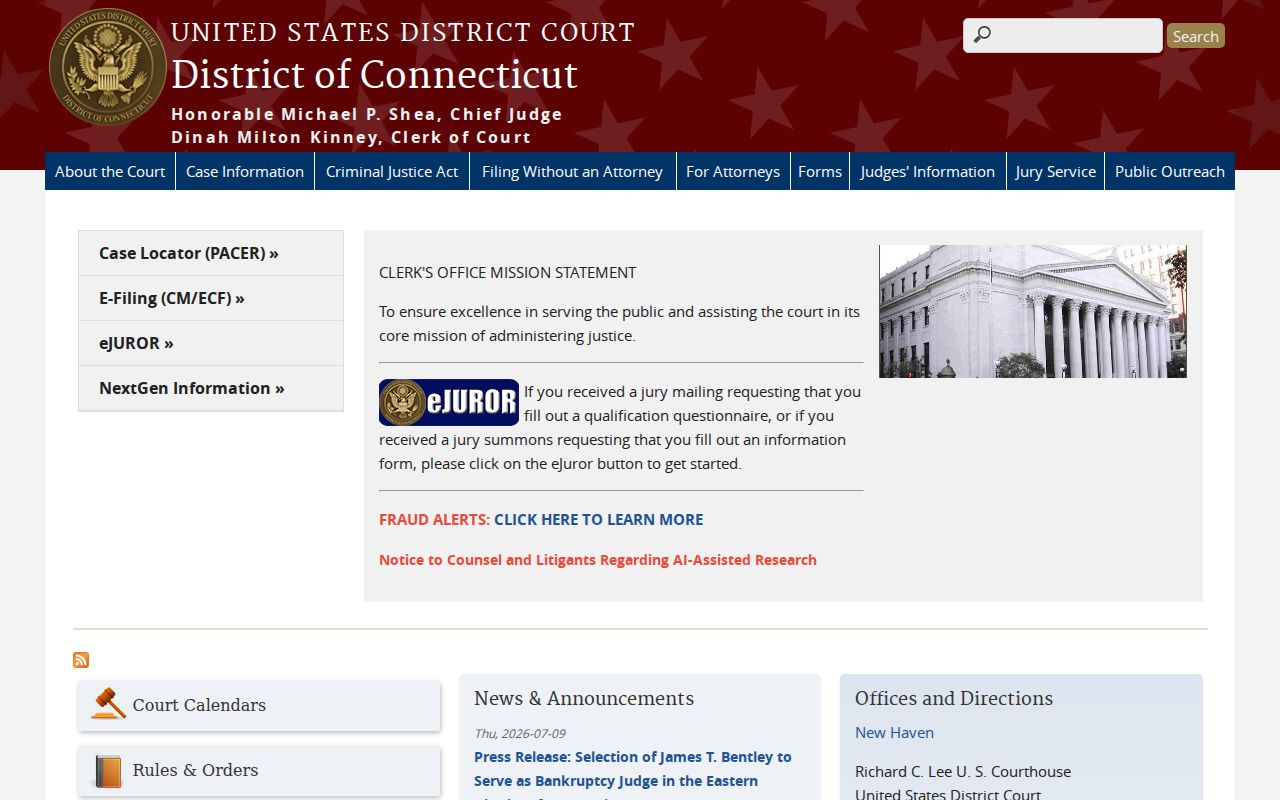
Keep federal and state results separate. They use different courts, custody agencies, identifiers, and request rules.
Fairfield Criminal Records by City
This project covers one Connecticut municipality. Fairfield Police creates the local incident and arrest records, but Connecticut agencies handle criminal court, custody, repository, registry, probation, and parole functions. The Fairfield locality profile ties those exact channels together without inventing county or municipal criminal offices.
Fairfield Criminal History
Town police reports at Reef Road, state court records in Bridgeport, and Connecticut repository and custody channels